Dedicated Circuit Cost in 2026: What a New Line Really Costs, Which Appliances Need One, and the Four Things That Turn a $300 Job Into a $2,200 Job
The quote said “dedicated circuit for the microwave: $1,850.” The homeowner had budgeted $400, and nothing in that quote was dishonest. The electrician had priced forty feet of cable through a finished kitchen wall, a dual-function breaker, drywall patching, and a permit. The $400 in the homeowner’s head was for a job where the panel sits on the other side of that wall.
That gap is almost never about the hourly rate. It is about four variables nobody asks about on the phone, and about a vocabulary problem: “dedicated circuit” gets used to describe everything from a $280 Saturday job to a $2,400 rebuild, and the two quotes in your inbox may not be describing the same work.
I have spent more than seven years on the maintenance side of power distribution — the person who inherits somebody else’s circuit years later and finds out whether it was sized right. The failures I find are rarely dramatic. They are a 20-amp circuit carrying a microwave, a coffee maker, and a toaster through one molded adapter, warm at the plug, working fine right up until it isn’t.
This is the practical version: what a dedicated circuit is, which appliances actually require one, what each type costs in 2026, what drives the price, and how to check whether the outlet you already have is dedicated before you pay anyone.
What a Dedicated Circuit Actually Is
A dedicated circuit — the code term is an individual branch circuit — is one overcurrent device feeding one load. That is the whole definition. It is about what the circuit supplies, not how many receptacles are on it. A single 20-amp breaker feeding four countertop receptacles that serve only the microwave is still, functionally, dedicated to the microwave.
Everything else in a house is a general-purpose branch circuit: one breaker, many outlets, many small loads that are never on at the same time. That design assumption is fine for lamps, chargers, and a television. It falls apart the moment you put two heating appliances on the same 15-amp run.
Two code mechanics make dedicated circuits more than a nicety:
Continuous load. A load expected to run three hours or more gets sized at 125% of its rating (NEC 210.19(A)(1) and 210.20(A)). A storage water heater of 120 gallons or less is defined as a continuous load outright (422.13), and EV charging is treated as continuous under Article 625. That is why a 40-amp car charger needs a 50-amp circuit and a 4,500-watt water heater needs a 30-amp breaker rather than a 20.
Manufacturer instructions. NEC 110.3(b) requires listed equipment to be installed in accordance with its listing and instructions. When an appliance’s installation sheet says “connect to an individual branch circuit,” that sentence has the force of code in practice, whether or not Article 210 mentions the appliance by name. This is the single most misunderstood point in every forum thread about microwaves.
Which Appliances Need One — and Which Only Want One
Here is the honest split. Only a handful of appliances are named in the code. Most are governed by their instructions, which amounts to the same requirement with a different paper trail.
| Appliance | Circuit | Why it needs its own line | What shared service looks like |
|---|---|---|---|
| Electric range / oven | 40–50A, 240V | Code-required; nameplate drives the exact size | Not shareable in practice |
| Electric dryer | 30A, 240V | Code-required; 5,500W is 23A by itself | Not shareable |
| Storage water heater | 30A, 240V | Continuous load per 422.13; 4,500W = 18.75A × 1.25 | Not shareable |
| Tankless electric water heater | 2–3 circuits, 40–60A each | 18kW and up; often forces a service upgrade | Not shareable |
| EV charger | 40–60A, 240V | Article 625; continuous load | Not shareable |
| Central AC / heat pump | Per nameplate, usually 240V | Motor circuit rules, Articles 430 and 440 | Not shareable |
| Dishwasher | 20A, 120V | Instructions; 1,200–1,500W with heat dry | Trips during dry cycle |
| Garbage disposal | 20A, 120V | Instructions; 1/2 hp ≈ 700W running, 2–3× on start | Dims lights on start |
| Over-range microwave | 20A, 120V | Instructions; 1,500W input | Trips with any second heat load |
| Countertop microwave | 20A, 120V | Instructions on most units; 1,500W input | Trips with coffee maker |
| Washing machine | 20A, 120V | Instructions; GFCI required in laundry areas | Nuisance trips on spin |
| Sump pump | 20A, 120V | Recommended, not required; motor inrush is the issue | Nothing else may run during a storm |
| Refrigerator / freezer | 15–20A, 120V | Recommended, not required | Compressor start dims the room |
| Window AC | 15–20A, 120V | Individual circuit per instructions on larger units | Trips on hot afternoons |
Two rows in that table are the ones people argue about. A refrigerator does not legally require a dedicated circuit in a dwelling, and plenty of houses have run one on a shared kitchen circuit for thirty years. But the compressor’s starting surge is the largest single-event draw in a normal house, and it is the reason a freezer on a shared circuit is a bad idea in a house with a window unit. I have replaced more food than I care to count because someone put the chest freezer on the same circuit as the garage door opener.
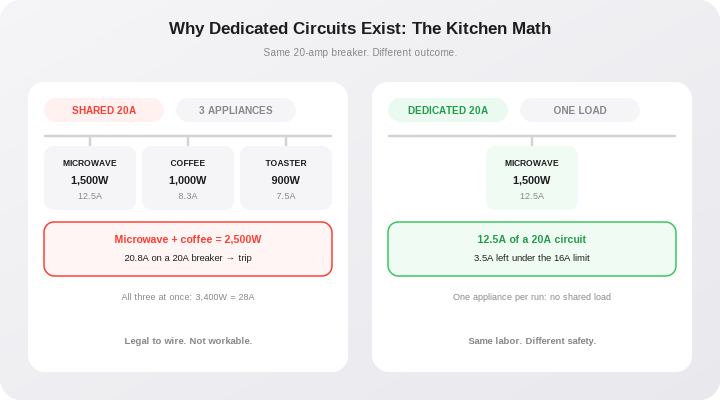
The countertop microwave row is the other one. Strictly speaking, Article 210 does not require it. Read the sheet that came in the box, and it will almost certainly tell you to use one. On a 20-amp circuit with other outlets, any single cord-and-plug appliance is limited to 16 amps (210.23(A)(2)), so a 1,500-watt microwave at 12.5 amps is legal on a shared circuit. It is legal and it will trip the moment someone starts coffee. Legal is not the same as workable.
What a Dedicated Circuit Costs in 2026
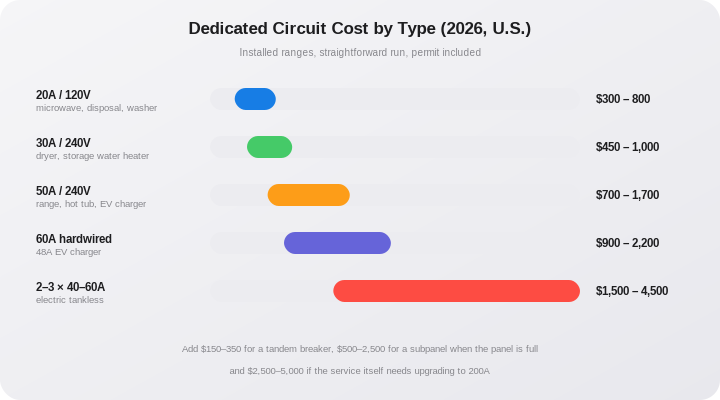
These are national ranges for straightforward work in 2026, assuming an accessible route, a panel with a free space, and a licensed electrician at $95 to $175 per hour. High-cost metros run 1.5 to 2 times these numbers; rural areas come in below.
| Circuit | Typical use | Installed cost (2026) | What sets the number |
|---|---|---|---|
| 15A / 120V | Gas furnace, small freezer | $250 – $600 | Short run in open basement |
| 20A / 120V | Microwave, disposal, washer, sump | $300 – $800 | Dual-function breaker, wall finish |
| 20A / 120V, long or finished run | Kitchen island, detached shed | $700 – $1,400 | 50–80 ft, patching, conduit |
| 30A / 240V | Dryer, 4,500W water heater | $450 – $1,000 | 10-gauge copper, dryer box |
| 40A / 240V | Range, some cooktops | $600 – $1,300 | 8- or 6-gauge, cord and receptacle |
| 50A / 240V | Range, hot tub, EV charger | $700 – $1,700 | Wire size, GFCI breaker, exterior |
| 60A / 240V hardwired | 48A EV charger | $900 – $2,200 | Conduit and THHN when NM-B is too small |
| 2–3 × 40–60A | Whole-house electric tankless | $1,500 – $4,500 | Service capacity, usually an upgrade |
Costs that stack on top rather than sit inside those ranges:
| Add-on | Cost | Note |
|---|---|---|
| Tandem breaker to free a space | $150 – $350 | Only where the panel is listed for tandems |
| Subpanel because the panel is full | $500 – $2,500 | See the subpanel cost guide |
| Service upgrade, 100A → 200A | $2,500 – $5,000 | See the panel upgrade cost breakdown |
| Permit and inspection | $50 – $250 | Higher in some cities; never skip it |
| Drywall repair per opening | $150 – $400 | Rarely in the first quote |
Where the Money Actually Goes
Strip out labor and a 20-amp circuit is a cheap object. The parts for a 25-foot run:
- 12/2 NM-B cable, $0.85–$1.15 per foot at 2026 retail on a 250-foot spool
- 20-amp single-pole breaker, $8–$15, or a dual-function AFCI/GFCI breaker at $55–$120
- One duplex or single receptacle and a box, $10–$25
- Staples, connectors, a couple of feet of slack, $5–$10
That is $60 to $200 in material for a $300 to $650 job. The rest is time: 1.5 to 3 hours for an open-basement run, 4 to 7 hours once you are fishing through finished walls and patching afterward. Labor is the entire cost story, which is why the same circuit quoted at $450 and $1,300 is usually a difference in access, not integrity. Ask both contractors how many hours and what access they assumed, and the two quotes reconcile fast.
A 240-volt appliance circuit inverts that ratio. The wire is the expensive part:
| Cable | 2026 rough cost | Typical use |
|---|---|---|
| 10/3 NM-B | $2.00 – $2.80 / ft | Dryer, NEMA 14-30 |
| 8/3 NM-B | $3.00 – $4.00 / ft | 40A range |
| 6/3 NM-B | $4.50 – $6.00 / ft | 50A range, 14-50 outlet |
| 6 AWG THHN, three conductors in 3/4" EMT | $2.50 – $4.00 / ft in place | Hardwired 60A EV charger |
A 60-foot 6/3 run is $270 to $360 of copper by itself. That is why moving a range ten feet closer to the panel can save more than shopping around for a cheaper electrician.
The Four Things That Turn a $300 Job Into a $2,200 Job
1. The panel has no space. This is the most common. If every slot is full and the panel is not listed for tandems, your options are a tandem breaker where permitted ($150–$350), a subpanel ($500–$2,500), or a panel replacement. The trap is that “full” and “at capacity” are different conditions. A panel can be physically full with plenty of load headroom, in which case a subpanel solves it for a fraction of a service upgrade. It can also have empty spaces and be at its limit, in which case a new circuit is the thing that finally trips the main on a July afternoon.
2. The service is at its limit. A 100-amp service with an electric range, a dryer, and central air has very little left for a 50-amp addition. The only honest way to know is a load calculation on your actual house, not a sum of breaker handles — handle ratings add up to far more than the service on almost every panel ever installed. If the calculation says no, the fix is an upgrade, and that is a different budget.
3. The wall is finished. Fishing a cable through a finished wall is skilled, slow work, and somebody has to patch and paint afterward. An electrician who quotes a finished-wall run at the open-basement price is either planning to surface-run conduit on your kitchen wall or planning to leave you a hole.
4. The run is long, exterior, or in conduit. Exterior work adds conduit, expansion fittings, and often a trench at $10 to $25 per foot plus 811 locating before you dig. Past about 75 feet, a 20-amp 120-volt circuit usually needs to go up a wire size to hold voltage under 3% drop. That is not upsell; it is arithmetic. A 100-foot run of 12-gauge carrying 16 amps loses about 6 volts, which lands you at the bottom of the acceptable range before the appliance even starts.
Wire Size and the 125% Rule
Two numbers decide whether a dedicated circuit passes inspection, and neither is on the breaker label.
The 125% rule. Size the conductor and the breaker at 125% of any continuous load, plus 100% of the noncontinuous load (210.19(A)(1), 210.20(A)). A 4,500-watt water heater at 240 volts draws 18.75 amps; ×1.25 = 23.4 amps, so it gets a 30-amp breaker and 10-gauge copper. A 40-amp EV charger at 240 volts needs 50 amps. Skip the multiplier and the circuit works fine until a summer afternoon, then nuisance-trips forever.
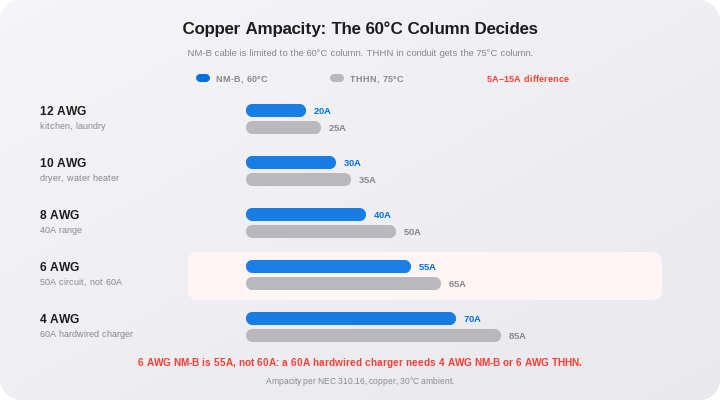
The 60-degree column. This is the trap that fails more inspections than any other in residential work. NM-B cable — the plastic-sheathed Romex in your walls — must be sized from the 60°C ampacity column (NEC 334.80), not the 75°C column printed on the wire jacket.
| Copper size | 60°C ampacity (NM-B) | 75°C ampacity (THHN in conduit) | What it is good for |
|---|---|---|---|
| 14 AWG | 15A | 20A | Lighting, bedrooms |
| 12 AWG | 20A | 25A | Kitchen, laundry, microwave |
| 10 AWG | 30A | 35A | Dryer, water heater |
| 8 AWG | 40A | 50A | 40A range |
| 6 AWG | 55A | 65A | 50A circuits; not a 60A NM-B run |
| 4 AWG | 70A | 85A | 60A hardwired charger |
| 3 AWG | 85A | 100A | 100A feeder |
Read the 6 AWG row again. Six-gauge copper is 65 amps at 75°C and only 55 amps as NM-B. So a 60-amp hardwired EV charger cannot be fed with 6/2 Romex, even though six-gauge “sounds like 60 amps” and half the internet says so. It needs 4-gauge NM-B or 6-gauge THHN in conduit. This is exactly the kind of detail that separates a $900 quote from a $2,200 quote, and the cheaper one is sometimes cheaper because it is wrong.
The Kitchen Math That Explains Most Tripped Breakers
A 20-amp, 120-volt circuit is 2,400 watts. Apply the 80% rule for a circuit feeding multiple outlets and the usable continuous load is 1,920 watts. Three ordinary appliances:
- Microwave, 1,000 watts of cooking output → about 1,500 watts at the plug
- Drip coffee maker brewing → 900 to 1,200 watts
- Two-slice toaster → 800 to 1,100 watts
Any two of those together are 2,400 to 2,700 watts, which is 20 to 22.5 amps on a circuit rated for 20. The breaker is not defective. It is doing exactly what it was installed to do, and the only real fixes are a second circuit or a habit.
The same arithmetic explains the dishwasher and the disposal. Both are 20-amp loads in the code’s eyes, and both cycle a motor. Start the disposal while the dishwasher is in its heat-dry phase and you have two 12-amp loads on one 20-amp breaker. Some installation instructions permit sharing these two; most do not, and the ones that do assume they never run together. If you are paying for a circuit anyway, pay for two.
How to Tell If You Already Have One
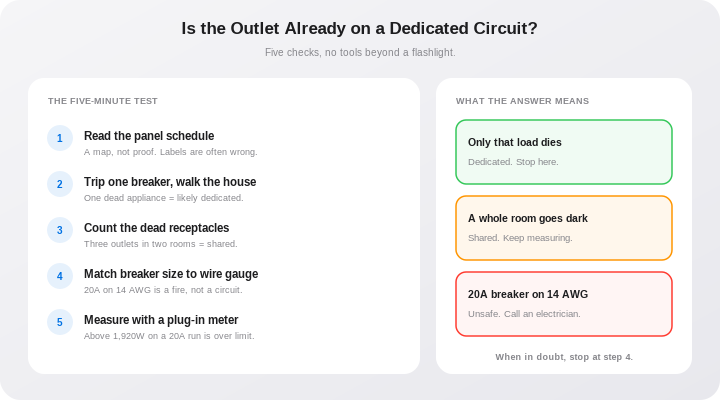
Five minutes, no tools beyond a flashlight, and you will know more than most homeowners ever do about their own panel.
- Read the panel schedule. The handwritten directory inside the door tells you what the last person believed. It is wrong often enough that you should verify, but it is a starting map — and if it is blank, that is a job in itself; here is how to label a panel properly.
- Trip one breaker and walk the house. If only the microwave dies, the circuit is dedicated or nearly so. If a bedroom, the hallway light, and the bathroom fan die with it, it is a general-purpose circuit wearing a misleading label.
- Count the dead receptacles. One is dedicated. Three in two rooms is not, no matter what the schedule says.
- Check the breaker size against the wire. A 20-amp breaker on 14-gauge wire is a fire waiting for a load. If you cannot read the jacket, stop here and call someone.
- Measure it. A plug-in watt meter between the wall and the appliance costs about $25 and removes all doubt. Run the appliance, note the watts, then switch on the other things on that breaker and watch the number climb. Anything sustained above 1,920 watts on a 20-amp circuit is over its continuous rating even if the breaker has not given up yet.
For the meter and the tester, the two tools that pay for themselves on the first job:
- Plug-in power meter (Kill A Watt style) — the only way to see actual appliance draw
- Circuit breaker finder — maps outlets to breakers without walking back and forth
- Non-contact voltage tester — verify dead before you touch anything
What a Competent Install Looks Like
You do not need to do the work to check it. These are the things an inspector looks at first, and the things that are expensive to discover later.
- The breaker matches the wire, not the appliance’s marketing. 12-gauge gets 20 amps, 14-gauge gets 15, 10-gauge gets 30.
- Terminations are torqued to the label. Panels print a range, typically around 25 to 45 inch-pounds for branch circuits. Hand-tight is not a specification, and loose neutrals are the number one cause of the warm cover plate people ignore for two years.
- The cable is secured and protected. Staples within 12 inches of every box and every 4.5 feet along the run, and physical protection where the cable passes through framing near the panel.
- GFCI and AFCI are where the code cycle puts them. A new kitchen circuit typically needs both, which is one dual-function breaker. If your quote has a plain $10 breaker on a kitchen circuit, ask why — the answer is sometimes a code cycle that has not been adopted in your area, and sometimes an electrician who plans to fail inspection.
- The panel schedule is updated. A new circuit with no label is a future service call. Write it down while the panel is open.
- There is a permit sticker or an inspection record. Skipping the permit saves $50 to $250 today and can cost you an insurance claim later.
When to Stop and Call Someone
Some houses should not get another circuit until something else is fixed. If you see any of these, the dedicated circuit is the second project.
- Aluminum branch-circuit wiring in a 1965–1972 house. Adding load to it without knowing its condition is how people end up with a warm receptacle. Here is how to identify aluminum wiring safely.
- A Federal Pacific Stab-Lok or Zinsco panel. These have a documented failure history and a dedicated circuit may be the load that finds out. Panel replacement becomes the first line item.
- A 60-amp service. There is no room for a 30-amp appliance circuit on a 60-amp service in a house with a water heater.
- A warm breaker, a scorched bus, or a smell of hot plastic. Stop using the circuit, not just the appliance. A tripping breaker is a symptom; the difference between an overload and a fault decides whether you have a habit problem or a wiring problem.
- A quote that has no permit, no load calculation, and no wire size. Any two of those missing means you are buying labor, not a circuit.
The Bottom Line
A dedicated circuit costs $250 to $800 for a 20-amp, 120-volt run in an accessible part of the house, $450 to $1,000 for a dryer or storage water heater, and $700 to $1,700 for a 50-amp appliance or EV charger. The number moves for exactly four reasons: panel space, service capacity, wall finish, and run length. Get those four answers before you compare quotes, and the spread between bids stops looking like a pricing mystery.
The technical rules are simpler than the pricing: size the conductor for 125% of a continuous load, size it from the 60°C column if it is NM-B, and put GFCI and AFCI where your code cycle requires them. Everything else is access and labor.
If your project is a vehicle charger rather than an appliance, the circuit is the smaller half of the decision — the full EV charger installation guide covers equipment, permits, and the load-management options that avoid a service upgrade entirely.
Frequently Asked Questions
How much does it cost to run a dedicated circuit in 2026?
For a straightforward 20-amp, 120-volt circuit with a run under 25 feet through an open basement or attic, expect $250 to $650 installed. The same circuit through a finished wall or past 50 feet runs $550 to $1,100. A 240-volt appliance circuit is $450 to $1,000 for a dryer or storage water heater and $600 to $1,700 for a range, hot tub, or EV charger. If your panel has no free spaces, add $150 to $350 for a tandem breaker or $500 to $2,500 for a subpanel. If the service itself is at its limit, a 200-amp upgrade is $2,500 to $5,000 and is a different job entirely.
Does a microwave really need a dedicated circuit?
In most cases, yes, but not because the electrical code names microwaves. Article 210 does not require a dedicated microwave circuit. The requirement comes from the installation instructions, which almost every over-the-range and many countertop units carry, and NEC 110.3(b) requires listed equipment to be installed in accordance with those instructions. The practical case is just as strong: a 1,000-watt-output microwave draws roughly 1,500 watts at the plug, which is 12.5 amps at 120 volts. Put a coffee maker or a toaster on the same 20-amp circuit and you are past the 16-amp continuous limit without trying.
Does a new dedicated circuit need GFCI or AFCI protection?
Usually both, and often in one breaker. AFCI protection is required on most 120-volt, 15- and 20-amp branch circuits in a dwelling, including kitchens, laundry rooms, and living areas under current code cycles. GFCI is required for 125-volt receptacles in kitchens, laundry areas, garages, unfinished basements, crawl spaces, bathrooms, outdoors, and near sinks, and recent cycles extended it to specific appliances such as dishwashers. A dual-function AFCI/GFCI breaker costs roughly $55 to $120 versus $8 to $15 for a plain breaker, which is why a kitchen circuit quote is higher than a bedroom circuit quote for identical wire and labor.
How can I tell whether an outlet is already on a dedicated circuit?
Trip one breaker and walk the house. If only the one appliance goes dead, the circuit is dedicated or close to it. If a whole room, a hallway, and the bathroom lights go out with it, it is a general-purpose circuit. Confirm against the panel schedule, then verify with a plug-in watt meter: run the appliance and watch the draw while you switch on other loads on the same breaker. A circuit that carries more than about 16 amps with normal use on a 20-amp breaker is already at its continuous limit.
Can I run a dedicated circuit myself?
In many jurisdictions a homeowner can pull an electrical permit for their own primary residence and do the work subject to inspection, but a new circuit is a poor first project. You have to size the conductor for the actual load, apply the 125% rule for continuous loads, choose AFCI or GFCI protection correctly, torque terminations to the value printed on the panel label, and staple and protect the cable to code. The failure modes are invisible: a loose neutral or an undersized ground sits quietly for years and shows up as a warm cover plate or a fire. If you have never terminated a breaker, hire the first one and watch what they do.