GFCI vs AFCI: What's the Difference (and Which Does Your House Actually Need?)
Most breaker panels tell the same story twice. A homeowner buys a replacement for a dead bathroom outlet, gets it home, and finds the old one was never a GFCI in the first place - just a standard receptacle that should never have been there. Someone else looks at a bedroom breaker with a tiny test button, decides “that must be the GFCI,” and cannot understand why it trips when the vacuum cleaner runs.
The two devices look similar, both carry a test button, and both get described as safety breakers. They are not the same device, they do not protect against the same thing, and mixing them up has real consequences - either you buy the wrong part, or worse, you “solve” a tripping safety device by replacing it with a standard one.
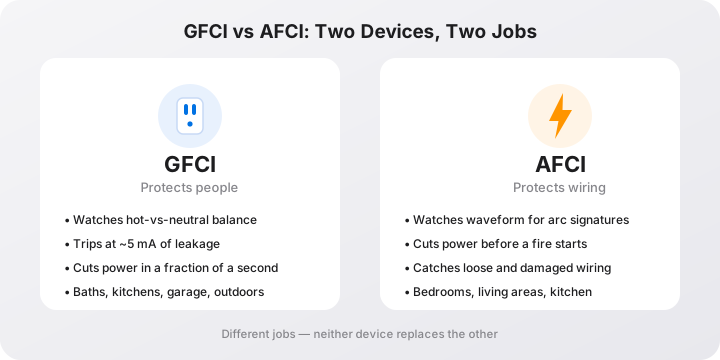
Here is the difference in one line: a GFCI protects people from shock. An AFCI protects the house from fire. Everything else - where each one goes, what they cost, how they misbehave - follows from that split.
The Short Answer
| GFCI | AFCI | Dual-function breaker | |
|---|---|---|---|
| Protects | People (shock) | Wiring (fire) | Both |
| How it senses | Current imbalance between hot and neutral | Waveform signature of an arc | Both methods |
| Trigger | ~5 mA of leakage | Sustained arcing | Either condition |
| Typical device | Receptacle (also sold as a breaker) | Breaker | Breaker |
| Typical part cost | $18-30 | $50-75 | $60-95 |
| How it is tested | TEST/RESET buttons on the device | TEST button on the breaker | Both buttons |
| Does not catch | Arcs, overloads | Shocks, overloads | Overloads only |
That last row matters: neither device is overload protection. On a small overload, the thing that saves your wiring is the breaker’s amperage rating - not either of these. A 20-amp breaker protects the 20-amp circuit the same way it always has, and a GFCI or AFCI added to that circuit does not change the number.
How a GFCI Works - and What It Cannot Do
A GFCI watches the current on the way out and the current on the way back. Everything that leaves on the hot wire should return on the neutral. If the two differ by even a few milliamps, that missing current is taking a different path to earth - through water, through a tool casing, or through a person standing in the wrong place.
The trip threshold is around 5 milliamps, and the response is a fraction of a second - fast enough that the shock is startling rather than lethal. That is the entire design goal. It is why GFCIs have been required in bathrooms, garages, and outdoors since the 1970s: those are the places where a person and a ground path meet water.
Two things a GFCI is commonly blamed for but does not do. It does not protect electronics from surges - a nearby strike can actually damage the GFCI itself, which is one reason we test them after storms. And it cannot see arcs at all: a loose connection arcing inside a wall box will not move a single milliamp, and the GFCI will never know it happened.
One practical detail worth knowing: a GFCI receptacle also protects the outlets wired downstream of it on its load side. One device can cover several points of use, which is why a kitchen sometimes has one cluster of dead outlets when a single GFCI has tripped. When an outlet near the sink is dead, the first thing to find is the GFCI upstream - often in an adjacent room. And for anyone planning smart home devices on GFCI-protected circuits, there is one nuance to file away: some no-neutral dimmers run on a trickle of current through the load, and in some installations that can nuisance-trip a GFCI. Nothing dangerous - but worth knowing before you spend an evening staring at a dimmer.
How an AFCI Works - The Fire Story
An AFCI listens to the shape of the current waveform. Normal electricity is a clean sine wave. An electrical arc - the sputtering, spitting discharge across a broken conductor, a loose terminal screw, or a nail through a cable - distorts that shape in a characteristic way, with rapid erratic spikes riding on the wave. An AFCI samples the waveform continuously, looks for that signature, and trips on sustained arcing before it can heat up whatever it is touching.
The naming trips people up, so let us settle it. Because arc detection came in generations, you will see “branch/feeder” and “combination” AFCI types; the type sold for homes today is combination type, meaning it detects both series arcs (a break in one conductor) and parallel arcs (line-to-line or line-to-ground). “Combination AFCI” - sometimes written CAFCI - has nothing to do with combining GFCI and AFCI in one device. A device that does both jobs is a dual-function breaker, and that is a different product with a different label.
Why did code start requiring AFCI protection in bedrooms in 1999? Because the fires that arc faults start happen behind walls and under floors where nobody is watching, and they tend to start where connections are: old wiring and its terminations. The aluminum branch-circuit era of the late 1960s and early 1970s, loose backstab outlets, nicked conductors, rodent-chewed cables - all classic arc scenarios, and most of them start while the house is asleep. That is why the requirement began with bedrooms and grew outward from there.
Where the Code Requires Each One
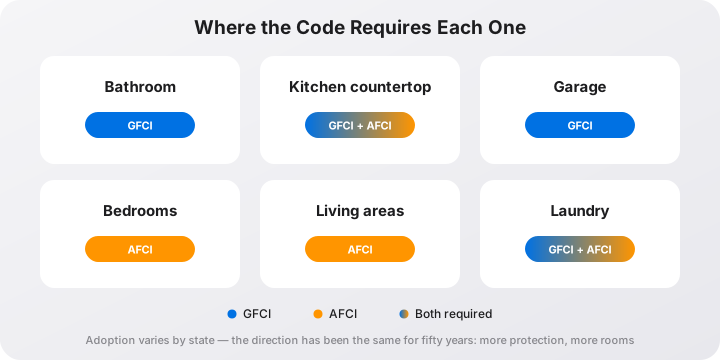
The exact list depends on which code edition your state has adopted, but the direction of travel has been consistent for fifty years: more protection, in more rooms. As adopted across most of the US:
| Location | GFCI | AFCI |
|---|---|---|
| Bathrooms, garages, outdoors | Since the 1970s | - |
| Kitchen countertops | Since 1987 | Since 2014 |
| Laundry and utility areas | Since the 1990s | Since 2014 |
| Unfinished basements, crawl spaces | Since the 1990s | - |
| Bedrooms | - | Since 1999 |
| Living areas (family, dining, halls) | - | Since 2008 |
| 240V receptacles, including EV charging | Since the 2020s | - |
The interesting rows are the ones with entries in both columns. A kitchen countertop circuit has required GFCI since 1987 and AFCI since 2014. Same story for laundry areas. When a circuit needs both, you have two ways to satisfy it: a dual-function breaker, or an AFCI breaker combined with GFCI receptacles at the required points. If you are installing a 240V outlet for EV charging, you will run into the GFCI requirement on the receptacle - and why many electricians now recommend hardwiring instead of an outlet, since two GFCI devices on one circuit can trip each other.
What Your House Actually Has
You can map your own protection in about fifteen minutes. This is the walk-through I do when homeowners send me panel photos.
- Look at the panel first. Open the door and read the breaker labels. A GFCI or AFCI breaker has a small test button on its face; the label will say GFCI, AFCI, or DF (dual function). No test buttons anywhere in the panel means no breaker-based protection - you may still have GFCI receptacles elsewhere in the house.
- Check every wet location. Bathroom, kitchen, garage, laundry, outdoors. A GFCI receptacle has TEST and RESET buttons on its face; standard receptacles do not. Press TEST - power should cut instantly. Press RESET to restore. If the device is old and the test button feels loose or does nothing, plan on replacing it.
- Apply the era rule. If the panel dates from before 1999, no AFCI protection is present unless it was added later. If the house predates the mid-1970s and the wet-room outlets are original, assume no GFCI coverage and verify by test.
Two findings are common, and both are fixable: wet-room outlets with no GFCI, and a panel with no AFCI anywhere. The first is a shock hazard you can fix cheaply. The second is a fire risk that shows up in statistics more than in daily life - but it is exactly the protection the code has required in bedrooms for a quarter century, and it is the reason a bedroom breaker carries a test button that its neighbors do not.
When One Keeps Tripping - The Right Way to React
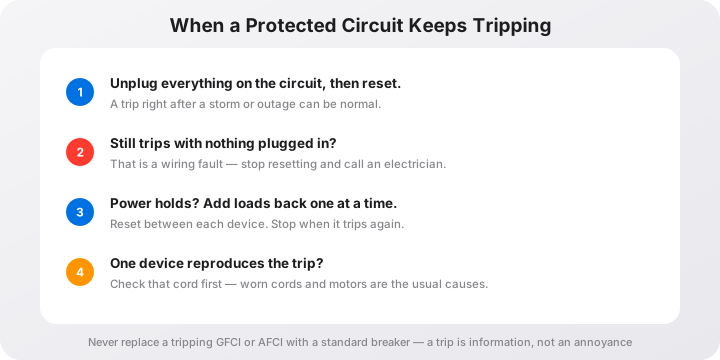
Here is the rule that governs everything below: a tripping GFCI or AFCI is never the problem by itself. It is reporting a problem. The fix is to find what it is reporting - not to replace the reporter with a device that will not complain. People who “fix” nuisance trips with a standard breaker are not fixing anything; they are disabling a safety device, which is exactly the outcome every code cycle since the 1970s has tried to prevent.
GFCI keeps tripping
The usual suspects, in the order I check them:
- Moisture in an outdoor or garage box - the classic post-rain trip. Dry it out, then watch whether it repeats.
- An aging motor, most often a refrigerator or freezer. A fridge that trips its GFCI repeatedly is telling you about its compressor, not about the GFCI - we covered that pattern in the refrigerator and appliance protection guide.
- A surge event. After a nearby strike or a utility event, GFCI devices are sometimes the casualty. If it will not reset after everything is unplugged, replace it.
- Actual water where it should not be - a slow leak onto a basement outlet, condensation in a spa or pool panel. Fix the water, not the GFCI.
AFCI keeps tripping
Run the isolation drill:
- Unplug everything on that circuit. Reset the breaker.
- Trips again with nothing plugged in? That is a wiring fault - a shared neutral on an older multiwire circuit, a damaged conductor, a loose termination. This is electrician territory; stop resetting and make the call.
- Holds with nothing plugged in? Add devices back one at a time, resetting between each.
- One device reproduces the trip? Inspect its cord first. If the cord is fine and the device is a brushed-motor appliance - vacuum, treadmill, older power tool - you have found the known nuisance-trip category. The motor’s normal waveform noise looks a little arc-like to the detection circuit. An electrician can confirm the breaker is working as designed and discuss options; one of them is sometimes moving that load to a different circuit.
- Trips when adding any device? Suspect wiring, not devices.
One testing note most people miss: plug-in “AFCI testers” cannot actually create an arc, and their readings are unreliable - they can fail to trip a perfectly good breaker. The listed test method is the TEST button on the breaker itself. For GFCIs, a plug-in tester is genuinely useful, because it can simulate a ground fault through the tool rather than just pressing the button. After any extended outage, it is also worth walking the house and checking that no GFCI stayed tripped - the power outage preparation guide has the full post-outage checklist, and an unnoticed tripped GFCI on a sump pump is the classic expensive surprise.
Costs, Priorities, and What to Buy
Parts are cheap; labor is the real line item. Illustrative 2026 US prices:
| Item | Part cost (illustrative) | Notes |
|---|---|---|
| GFCI receptacle, 15/20A | $18-30 | Tamper-resistant versions add a few dollars |
| GFCI receptacle, weather-resistant | $22-40 | For outdoor locations |
| AFCI breaker | $50-75 | Must match your panel brand |
| Dual-function (AFCI + GFCI) breaker | $60-95 | One slot, both protections |
| Plug-in GFCI tester | $15-30 | Tests outlets including downstream ones |
A standard GFCI receptacle, an AFCI breaker for your panel brand, a dual-function breaker, and a plug-in GFCI tester cover almost everything a homeowner can reasonably do themselves.
For labor, expect a service minimum plus roughly $100-250 per device installed, with panel work priced at the higher end. A single receptacle swap is the one job on this list where a careful homeowner with a voltage tester can genuinely do the work: breaker off, circuit confirmed dead, wires moved one at a time. Opening the panel to install a breaker is a different category of task - if you have never worked inside a panel, that is a phone call, not a weekend project.
If the budget is limited, this is the priority order I give people:
- Missing GFCIs in wet locations. Highest shock risk, cheapest fix.
- Troubleshoot nuisance trips properly. Free, and it prevents the worst outcome - someone “fixing” it with a standard breaker.
- AFCI protection on bedroom circuits in pre-1999 homes. Fire risk where people sleep.
- A full upgrade to the current code across the house. Best done as part of a panel replacement or renovation, when walls are open and an electrician is already on site.
The Bottom Line
GFCI and AFCI are not competing products. They are two answers to two different questions. Do we keep current from going through a person? That is the GFCI, watching the balance and tripping at 5 milliamps. Do we keep a broken wire from turning into a fire? That is the AFCI, listening to the waveform for the signature of an arc. Some circuits need both answers, and a dual-function breaker gives both in a single slot.
The two habits that prevent almost every mistake: test the devices you have - monthly, and after storms or outages - and treat a trip as information, never as an annoyance to be silenced. If the information points at wiring, that is the moment to call an electrician. And that call is not a failure. It is the system working.
Frequently Asked Questions
What is the difference between GFCI and AFCI?
They protect against two different hazards. A GFCI (ground fault circuit interrupter) watches the current going out on the hot wire against the current coming back on the neutral. If they differ by even a few milliamps, some current is finding another path - possibly through a person - and the device cuts power in a fraction of a second. An AFCI (arc fault circuit interrupter) watches the shape of the current waveform for the signature of electrical arcing, the sputtering discharge that happens at a broken conductor or a loose connection, and trips before that arc can ignite what is behind the wall. Short version: GFCI protects people from shock, AFCI protects the house from fire. The names are not interchangeable, and neither device does the other's job.
Do I need both GFCI and AFCI protection?
Some circuits require both, and kitchen countertops and laundry areas are the common examples. You do not need two devices to satisfy that: a dual-function breaker (the label often reads DF, or AFCI/GFCI combination) delivers both protections in a single panel slot, and it is what I recommend where a circuit needs the pair. The alternative is an AFCI breaker combined with GFCI receptacles at the points of use. What you should never assume is that one covers the other - an AFCI does not provide the 5-milliamp shock protection of a GFCI, and a GFCI cannot see an arcing conductor. If a circuit is near water and in a living area, treat both as the default.
Why does my AFCI breaker keep tripping?
There are four usual causes, and the isolation drill tells them apart. Unplug everything on the circuit and reset. If it trips again with nothing plugged in, that is a wiring fault - a shared neutral on an older multiwire branch circuit is the classic one - and it is electrician territory. If it holds, add devices back one at a time. When one device reproduces the trip, inspect its cord first, then treat it as the known nuisance category if it has a brushed motor (vacuum, treadmill, older power tool): those motors produce waveform noise that arc detection can flag. Trips that appear only when adding any device point at wiring, not devices. And never solve any of this by swapping in a standard breaker.
Why won't my GFCI outlet reset?
Three common reasons, in the order I check them. First, no power is reaching the device - if the upstream breaker is off or tripped, or the outlet is on a circuit that is simply dead, there is nothing to reset. Second, the device itself may be miswired or at the end of its service life; GFCIs include electronics that age, and a unit that fails its TEST button has failed its job. Third, and most important: the GFCI may be sensing a real fault downstream and refusing to restore power to it. That is not stubbornness - that is the device working. With everything unplugged, press reset once more. If it will not hold, stop resetting it and have the circuit checked.
How much does it cost to add GFCI or AFCI protection?
Parts are modest; labor is the real line item. Illustrative 2026 US prices: a GFCI receptacle runs about $18-30, a weather-resistant one for outdoor use $22-40, an AFCI breaker $50-75, and a dual-function breaker $60-95. Having an electrician install a single device typically adds a service minimum plus $100-250 depending on access and region, and panel work is priced at the higher end. Most people get the best value starting with two fixes: replacing missing GFCIs in wet locations (highest shock risk, and it is a direct receptacle swap a careful homeowner can often handle) and adding AFCI protection to bedroom circuits in homes built before 1999 (fire risk while people sleep).