Knob-and-Tube Wiring: How to Identify It, What Replacement Costs, and What Insurers Really Ask (2026)
Knob-and-tube wiring is the thing a home inspector finds, points at, and describes in a tone that makes buyers reach for their phone. Half of what gets said next is too alarming, and half is too casual. The wiring is neither a death sentence nor a cosmetic quirk.
I have spent more than seven years maintaining critical-infrastructure power systems, where conductors are sized, protected, and inspected on the assumption that someone’s life depends on the calculation. Old houses run the same physics with none of the instrumentation. That is the right way to think about knob-and-tube: not as “old wire,” but as a system with a fixed thermal budget and no margin for the things people have added around it.
This guide is the sequence I use: identify it properly, understand the five ways it actually fails, deal with the insurance question before it deals with you, and price the work by scope rather than by scary headline number.
What Knob-and-Tube Wiring Actually Is
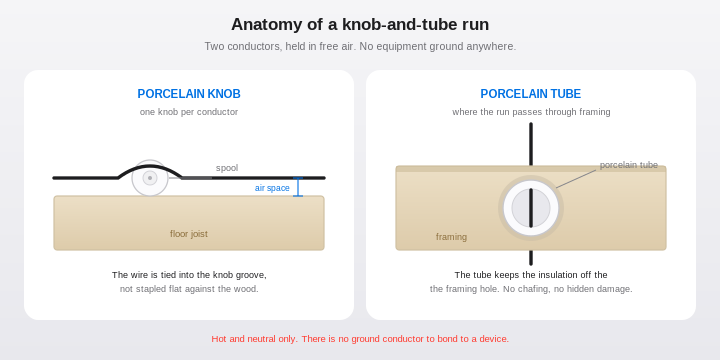
Knob-and-tube was the standard wiring method in North American houses from roughly the 1880s into the 1940s, lingering into the 1950s in some markets. It is a two-wire system: a hot conductor and a neutral, run separately, with no equipment grounding conductor anywhere.
The name describes the hardware. Knobs are porcelain spools nailed to the sides of joists and studs. The conductor is tied around each knob with a short piece of the same wire, which holds it away from the wood and keeps it under tension. Tubes are porcelain sleeves inserted into holes drilled through joists, top plates, and studs, so the conductor passes through framing without touching it.
The conductors themselves are usually 14 or 12 AWG copper, sometimes tinned copper in the earliest installations, covered in a rubber compound with a cotton braid over it. Where two runs cross or enter a fixture, the wire may be protected by flexible black loom. Splices were made by twisting, soldering, and wrapping with friction tape, often in open air rather than inside a box.
Two details matter more than the rest. First, the conductors are spaced several inches apart and surrounded by air. That spacing is not sloppy workmanship; it is part of the thermal design. Second, the system was sized for a house whose electrical load was lighting, a radio, and maybe a refrigerator. A 30- or 60-amp service was normal. Nobody was planning for a 1,500-watt space heater in every bedroom.
Why Some of It Is Still Working
Rubber insulation degrades slowly in a dry, cool, ventilated space. An attic or an open basement is exactly that. This is why the same wiring that crumbled to dust at a receptacle box can look almost new where it runs across the joists, and why so many houses have a hybrid: knob-and-tube in the attic and basement, modern cable in the rooms that have been remodeled.
That is also why “the inspector found knob-and-tube” is not by itself a finding you can price. The question is where it runs, what has been done to it, and what is plugged into it.
The failure mode of knob-and-tube is not spontaneous combustion. It is a system that worked because it was left alone, and then someone buried it, overfused it, extended it, or loaded it like a modern circuit.
How to Identify It in Ten Minutes
Start where the wiring is exposed. An attic, a basement, a crawlspace, or a garage with unfinished walls will tell you more in five minutes than a whole-house tour of finished rooms.
| What you are looking at | What it means | What to do |
|---|---|---|
| Porcelain spools nailed along the sides of joists, with wire tied around them | Knob-and-tube, almost certainly original | Photograph it, note the rooms it feeds, do not move it |
| Porcelain tubes set into drilled holes in framing | Knob-and-tube passing through wood | Same, and check for crumbling insulation at each tube |
| Single conductors with a cloth braid and no outer jacket | Knob-and-tube or early rubber-insulated wiring | Treat as ungrounded and fragile until proven otherwise |
| A fuse panel with round Edison-base fuses | An older service, often paired with knob-and-tube | Check fuse sizes against circuit wire size before anything else |
| Two-prong receptacles throughout the house | No equipment ground at those outlets | Read the grounding guide before changing any of them |
| Solder-and-tape splices hanging in open air | Original practice, now a weak point | Do not disturb; have an electrician evaluate and box what is accessible |
| Modern cable in the kitchen, knob-and-tube in the attic | A partially updated house | Map which circuits are which before planning work |
A flashlight and a phone camera are enough for the visual pass. A non-contact voltage tester is the one tool I would not skip, because it tells you whether a circuit is actually dead before you open anything. Wear gloves, and do not pull, bend, or staple anything you find. Rubber insulation that looks intact can crack the moment it is moved, and the conductor underneath may be fine right up until it is not.
The panel is the second half of the identification. Open the cover only if you are comfortable doing so with the main off; otherwise photograph the labels and the fuse sizes through the cover. A 30-amp fuse on a circuit wired with 14 AWG is a finding, and it is a more urgent one than the presence of knobs in the attic.
The Five Ways It Actually Fails
1. Thermal Insulation on Top of the Conductors
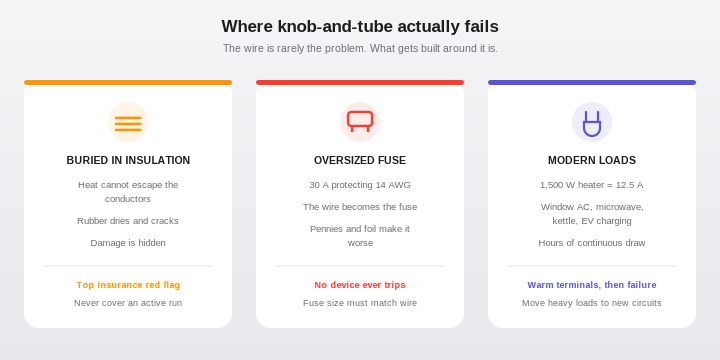
This is the big one, and it is the reason insurance companies ask about it first. Knob-and-tube conductors shed heat into the air around them. Blow cellulose over them, pack batt insulation between joists, or spray foam around a top plate, and that heat has nowhere to go. The rubber dries, shrinks, and cracks. The cotton braid becomes tinder.
The code’s provisions for concealed knob-and-tube wiring assume the conductors are in free air, and Article 394 of the National Electrical Code is written around that assumption. Covering the wiring does not just violate the spirit of the installation; it removes the thermal margin the design depended on. It also hides the wiring from every future inspection, which is how a small problem becomes a house-wide surprise.
If an insulation contractor offers to work around “a few old wires,” stop the job and get an electrician in first. The cheapest order is rewire the attic circuits, then insulate.
2. Overfusing: When the Wire Becomes the Fuse
A fuse protects the wire, not the appliance. The relationship is not optional: 14 AWG copper gets a 15-amp fuse, 12 AWG gets 20 amps, and 10 AWG gets 30. Those are the small-conductor limits in the code, and they exist because the insulation cannot survive the heat that a larger fuse would allow.
Old fuse panels invite mistakes. Edison-base fuses come in 15, 20, and 30-amp sizes and all fit the same socket. A 30-amp fuse in a 15-amp circuit will happily pass enough current to cook the wiring before it ever opens. Pennies behind fuses, foil wrapped around a blown fuse, and a “temporary” larger fuse are all the same decision: use the wiring as the fuse.
If the house still has a fuse panel, Type S fuse adapters are a cheap, code-recognized way to make it physically impossible to install a fuse larger than the circuit rating. They are not a substitute for a service upgrade, but they remove one specific way a household can accidentally burn the house down.
3. Brittle Insulation and Open Splices
Rubber insulation loses plasticizers as it ages. In a dry attic it can survive for decades. At a fixture box, where heat from an old incandescent bulb cycled through it for fifty years, it often turns to powder. The same happens where a conductor was bent around a knob and left under tension.
The splice is the second weak point. Soldered joints wrapped in friction tape were skilled work, but the tape dries and the joint sits in open air where nothing supports it. Add a ceiling fixture or a remodeling crew that moves the wires, and a joint that was electrically sound becomes a loose connection. A loose connection is a hot spot, and a hot spot in dry wood is the fire everyone worries about.
Any splice that is accessible should be evaluated. Any splice that is not accessible is a reason to plan replacement rather than a reason to feel reassured.
4. Modern Loads on Circuits Sized for Lighting
A 1,500-watt space heater draws 12.5 amps at 120 volts. A window air conditioner can draw 8 to 12 amps running and far more at startup. A microwave pulls 10 to 15 amps. An air fryer or a kettle can pull 12 to 15. An EV charged from a standard 120-volt outlet draws 12 amps continuously for hours, which is a harder duty cycle than any of them.
None of those loads is unreasonable in a modern house. All of them are unreasonable on a circuit that was designed for a few lamps and a radio, especially when the same circuit feeds half a room through daisy-chained receptacles. The failure is not instantaneous. It is cumulative: warm terminals, darkened insulation, a fuse that blows more often every summer, and an owner who eventually installs a bigger fuse.
If the house still has knob-and-tube, the honest rule is that high-draw appliances belong on new circuits. Space heaters, window units, microwaves, kettles, power tools, and EV charging are the loads to move first.
5. No Equipment Ground, and the Shortcuts People Take
Knob-and-tube has no grounding conductor. That was normal when it was installed; it is a limitation now. Three-prong receptacles on an ungrounded circuit are either protected by a GFCI and labeled as such, or they are a lie told by the shape of the outlet.
The dangerous shortcut is the bootleg ground: a jumper from the neutral terminal to the ground terminal. It makes every three-light tester read correct and turns the grounding pin into a current-carrying conductor. The two-prong outlet grounding guide walks through the legal fixes and why the tester cannot tell the difference.
The second-order cost is equipment protection. A surge protector needs a real ground to divert common-mode surges, the ones that arrive on hot and neutral together. On an ungrounded circuit it still clamps line-to-neutral, but it is working at half strength. The whole-house surge protection guide explains why the ground path is the part that makes the device work, and why a panel-level protector is the right place to solve it once the service is upgraded.
The Insurance Conversation
Insurers are not asking about knob-and-tube because they are sentimental about wiring methods. They are pricing a fire risk that is hard to see and expensive to fix. The questions on a typical application are blunt: does the home have knob-and-tube wiring, aluminum branch wiring, or a fuse panel?
The answers vary by carrier and state. Some will not write a new policy on a house with knob-and-tube at all. Some will write it with conditions, and the conditions are usually specific: no knob-and-tube buried in thermal insulation, no evidence of overheating at boxes, and a written inspection from a licensed electrician. Some will surcharge instead of declining. A few will accept a partial rewire as evidence that the risk is being managed.
What you should do about it:
- Ask before you make an offer. Call three carriers with the address and the inspection report. A quote on a house you do not yet own costs nothing and can save a five-figure surprise.
- Disclose it accurately. An application that says “no knob-and-tube” when the attic is full of porcelain knobs is a misrepresentation. It gives the carrier a clean reason to deny a claim years later.
- Get the acceptance in writing. A verbal “should be fine” from an agent is not a binder. Ask for the condition list in writing so you know what the carrier will inspect.
- Keep the electrician’s letter. If the carrier accepts an inspected system, the letter is the document that keeps the policy alive. Store it with the closing papers.
In some states, older homes go through a four-point inspection before a policy is written, covering roof, plumbing, electrical, and HVAC. Knob-and-tube is one of the items that inspection exists to find.
What Replacement Actually Costs in 2026
Replacement is priced by scope and access, not by square footage alone. A circuit that runs through an open basement is a different job from the same circuit behind plaster and a finished ceiling.
| Scope of work | What it covers | Typical U.S. range (2026) |
|---|---|---|
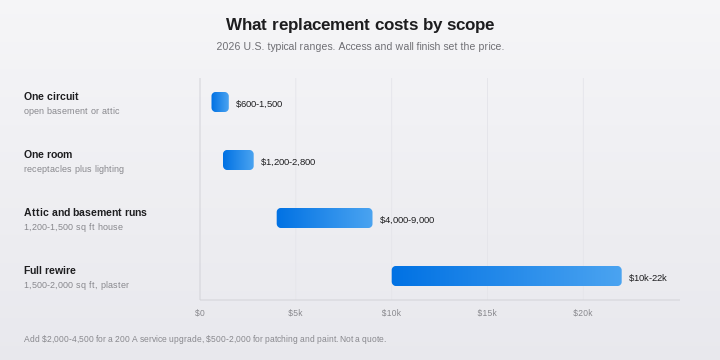
| One circuit, open access | Replace a single run from panel to first outlet, new grounded cable, new receptacle | $600-1,500 |
| Kitchen or laundry circuit | 20-amp GFCI circuit, new cable, new devices, appliance outlets | $900-2,000 |
| One room | Receptacles and lighting for a bedroom, living room, or bath | $1,200-2,800 |
| Attic and basement branches only | The exposed knob-and-tube runs in a 1,200-1,500 sq ft house, leaving wall runs in place | $4,000-9,000 |
| Full rewire, 1,500-2,000 sq ft | All branch circuits, new panel feeders, boxes, devices, patching | $10,000-22,000 |
| 200-amp service upgrade, added to a rewire | New service, panel, grounding electrode system, permit | +$2,000-4,500 |
| Drywall repair and paint | Patching the holes a rewire leaves behind | $500-2,000 |
Three things drive the number up faster than anything else. Plaster walls are slower to open and harder to patch than drywall. Old boxes are shallow, so every device replacement becomes a box replacement. And a full rewire usually reveals other work that has to happen at the same time: a service that cannot carry the new load, a grounding electrode system that was never installed, or a panel that has no space for new breakers. The panel upgrade cost guide is the right companion if the quote includes service work.
Ask every contractor one question before signing: does the quote remove the old knob-and-tube, or abandon it in the walls? Many electricians disconnect the old conductors at both ends and leave them in place because removal means opening every wall. That is often acceptable, but it leaves a surprise for the next remodeler and it should be stated in the contract, not discovered later.
If You Cannot Rewire This Year
A full rewire is a five-figure project, and most people cannot do it the month they learn they need it. Triage is a legitimate strategy as long as it is honest about what it does and does not fix.
- Map the circuits first. You cannot move loads off a circuit you cannot identify. The panel labeling guide has a one-breaker-at-a-time method that finds the hardwired loads as well as the outlets, and a circuit breaker finder saves a lot of walking on a house with unlabeled fuses.
- Get the high-draw appliances onto new circuits. Space heaters, window air conditioners, microwaves, kettles, power tools, and EV charging. This is the highest-value electrical work you can do before a rewire, and it is work that carries forward into the new system.
- Replace worn receptacles with GFCI protection where the code allows it. On an ungrounded circuit, a GFCI receptacle with the two required labels protects people. It does not create a ground. Do not install a three-prong receptacle with an empty ground screw and call it done.
- Do not add insulation over the wiring. Wait for the rewire, or rewire that space first. This is the one item where the cheap fix is the dangerous one.
- Do not extend knob-and-tube. New work should leave the panel on new cable. Splicing modern NM-B to brittle knob-and-tube in an attic junction box is how a circuit acquires a 90-year-old weak point at its most heavily loaded end.
- Keep a working smoke and CO alarm layer. It is not a substitute for safe wiring. It is the layer that gives you time if something goes wrong at 3 a.m. The hardwired alarm guide covers the wiring, the interconnect, and the ten-year replacement rule.
- Put the rewire on a schedule. A house with knob-and-tube is a house with a known capital expense. Price it, save for it, and do it in the order that removes the highest-risk runs first: attic runs under insulation, then kitchen and laundry, then the rest.
Buying or Selling a House With Knob-and-Tube
If you are buying, the inspection report is the start of the conversation, not the end. Ask the seller for any electrical permits and for the name of the electrician who did the last work. A house that has been “updated” often means the kitchen was rewired and the attic was not.
Get an insurance quote before removing your financing contingency. A carrier that declines the house changes the deal more than a $6,000 credit does. If you proceed, negotiate the credit against a written rewire estimate, not against a guess.
If you are selling, disclose what you know. Most states require it, and the buyer’s inspector will find the knobs anyway. A pre-listing electrical inspection that documents the condition of the wiring is cheaper than a renegotiation after the buyer’s carrier refuses to bind.
When to Stop and Call an Electrician
Stop touching it and call a licensed electrician if you find any of the following:
- Insulation that crumbles when you touch it, or bare conductor visible at a knob or tube.
- A fuse that blows repeatedly, or a fuse larger than the circuit wire size.
- Discolored or warm cover plates, a burning smell, or buzzing at a device.
- Charred wood, melted tape, or a splice that has been hot.
- Knob-and-tube buried under insulation, especially in an attic.
- Aluminum branch wiring anywhere in the same panel. The aluminum wiring identification guide covers why it needs a different repair.
- Any plan to add a major load, a subpanel, or an EV charger without a load calculation.
None of these is a do-it-yourself diagnosis. They are the point where the cost of an electrician is small compared to the cost of being wrong.
The Honest Summary
Knob-and-tube wiring is a 90-year-old system with a narrow thermal margin, no equipment ground, and a failure mode that is accelerated by exactly the improvements modern homeowners want to make: more insulation, bigger appliances, faster charging. It is not a reason to panic, and it is not a reason to ignore the inspection report.
The right sequence is identify it, stop covering it, move the heavy loads off it, insure it honestly, and budget the rewire. A house with a known electrical capital expense is a much better position than a house with a hidden one.
Frequently Asked Questions
Is knob-and-tube wiring dangerous?
Not automatically, and that is the honest answer. The original installation was engineered for the loads of its era, with conductors spaced apart in free air so heat could escape. A dry, undisturbed run in an open attic or basement can still be electrically sound. The danger comes from what happens around it: thermal insulation blown over the conductors, a 30-amp fuse protecting a 15-amp circuit, brittle rubber crumbling at a splice, or a modern space heater plugged into a circuit sized for lighting. Add the fact that there is no equipment ground, and the system has no margin for any of those mistakes. Age alone is a reason to plan replacement. A specific hazard is a reason to act now.
Will homeowners insurance deny coverage for knob-and-tube wiring?
It varies by carrier and by state, and no article can promise you an answer. Many insurers ask about knob-and-tube, aluminum branch wiring, and fuse panels on the application. Some decline new business outright. Others accept with conditions, commonly that the wiring is not buried in thermal insulation, that there is no evidence of overheating, and that a licensed electrician has inspected it and provided a letter. A few surcharge instead of declining. The practical move is to ask three carriers for a quote before you remove a purchase contingency, disclose the wiring honestly, and get the acceptance in writing. Misrepresenting it on an application is grounds for denying a claim later, which is the worst possible outcome.
How much does it cost to replace knob-and-tube wiring?
Typical 2026 U.S. ranges, and they depend almost entirely on access. Replacing one circuit through an open basement or attic runs about 600 to 1,500 dollars. A kitchen or laundry circuit with GFCI protection runs 900 to 2,000. A whole room's receptacles and lighting runs 1,200 to 2,800. Replacing only the attic and basement branches in a 1,200 to 1,500 square foot house runs 4,000 to 9,000. A full rewire of a 1,500 to 2,000 square foot house with plaster walls runs 10,000 to 22,000, plus 500 to 2,000 for patching and paint. Adding a 200-amp service upgrade at the same time adds roughly 2,000 to 4,500. These are planning numbers, not quotes.
Can I cover knob-and-tube wiring with insulation?
No. This is the single most common way a serviceable knob-and-tube system is turned into a hazard. The conductors were designed to shed heat into open air, and the rubber insulation is typically rated around 60 degrees Celsius. Blown cellulose, spray foam, or batt insulation traps that heat, dries the rubber further, and hides damage from anyone who might inspect it. It is also the first condition insurers ask about. If you want to insulate the attic, rewire the circuits in that space first, or at minimum have an electrician evaluate and reroute them. Insulation contractors are not electricians and will often blow right over what they find.
Can I install a GFCI outlet on knob-and-tube wiring?
Yes, and for an ungrounded circuit it is one of the few code-permitted ways to install a grounding-type receptacle. The GFCI must be marked GFCI Protected and No Equipment Ground, and so must every downstream outlet. Understand what it buys you: protection against a person being electrocuted by a fault, which is real and valuable. It does not create an equipment ground, it does not repair brittle insulation, and it does not make an overloaded circuit safe. If a GFCI trips repeatedly on old wiring, treat that as a signal to investigate the circuit, not as a defective device. An AFCI breaker is not a substitute either; on circuits with shared neutrals it may trip constantly, and it cannot fix insulation that has already failed.