Subpanel Installation Cost in 2026: 60A, 100A, and 200A Prices, Feeder Sizing, and When a Subpanel Beats a Service Upgrade
The quote said “subpanel, $4,800.” The house already had a 200-amp service with six empty spaces. What the contractor had actually priced was a service upgrade with a subpanel attached to it — a job the homeowner did not need, sold under the name of the job he had asked for.
That confusion runs in both directions and it costs real money. I have spent more than seven years on the maintenance side of power distribution, the person who inherits somebody else’s panel work years later and finds out whether it was done right. The recurring finding is not bad workmanship. It is work that was scoped wrong from the first phone call: a subpanel sold as a capacity fix, a service upgrade sold as a convenience, and a homeowner paying for whichever one the contractor happened to be good at.
This guide is the kitchen-table version: what a subpanel is, what it costs in 2026 by size and building type, what actually drives the price, the two code details that fail inspection most often, and how to know which job you are buying before you collect a single quote.
What a Subpanel Is — and the One Thing It Cannot Do
A subpanel is a second enclosure full of breakers, fed from the main panel by a single feeder circuit. Power flows main panel → feeder breaker → feeder conductors → subpanel → branch circuits. Every branch circuit in the subpanel is still protected by the breaker in the main panel that feeds the whole thing.
The reason to install one is almost always space. A panel that is full — every slot occupied, tandems already used, no way to add a circuit for a mini-split, a hot tub, or a workshop — has no physical place to land another breaker. A subpanel gives you 6, 12, or 24 new spaces and a short run to whatever you are feeding, instead of a long home run back to a packed main panel.
What a subpanel does not do is add capacity. The feeder breaker you install in the main panel is subtracted from the capacity you already had. If your 100-amp service was carrying an electric range, a dryer, and central air, adding a 100-amp subpanel does not give you 200 amps; it gives you a second place to trip the same 100-amp main. A subpanel is a distribution convenience. It is not an upgrade.
That distinction is the whole decision. If the service has headroom and the panel is out of spaces, a subpanel is the correct, cheap, code-compliant answer. If the service is at its limit, the answer is a service upgrade — and the panel upgrade cost guide walks through that number line by line.
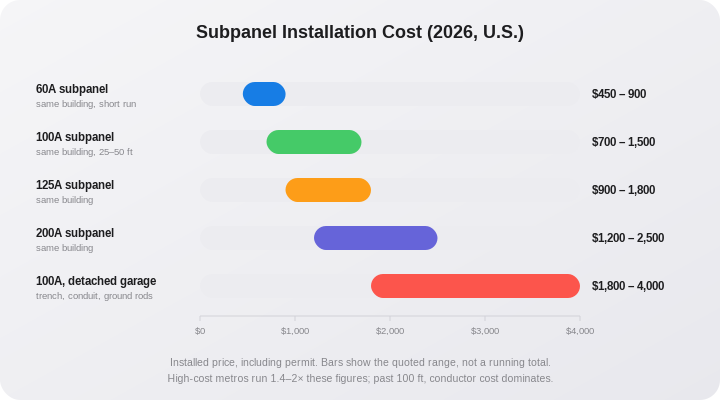
What Subpanel Installation Costs in 2026
These are installed prices — materials, labor, and permit — for a competent job in an average U.S. market. High-cost metros run 1.4 to 2 times these figures; rural areas can land below them. Treat them as ranges to sanity-check a quote, not as bids.
| Scope | Typical installed cost (2026) | What it usually includes |
|---|---|---|
| 60A subpanel, same building, run ≤ 25 ft | $450 – $900 | 6–8 space main-lug panel, 6 AWG copper feeder in conduit or cable, 60A breaker, permit |
| 100A subpanel, same building, run 25–50 ft | $700 – $1,500 | 12-space panel, 3 AWG copper or 1 AWG aluminum feeder, 100A breaker |
| 125A subpanel, same building | $900 – $1,800 | 12–16 space panel, 1 AWG copper or 2/0 aluminum feeder |
| 200A subpanel, same building | $1,200 – $2,500 | 8–12 space panel, 3/0 copper or 250 kcmil aluminum feeder, larger conduit |
| 100A subpanel, detached garage, ~50 ft trench | $1,800 – $4,000 | Trenching, PVC conduit, four-wire feeder, two ground rods, main-breaker panel |
| 100A subpanel, detached garage, 100+ ft | $3,000 – $6,000 | Conductor cost starts to dominate the job |
The single biggest multiplier is not amperage. It is where the panel goes. A subpanel back-to-back with the main panel, in an open basement, is a half-day job. The same subpanel 80 feet away through a finished wall, or buried across a lawn to a detached garage, is two days and a different category of money.
Materials, for reference, so you can see what a quote is marking up:
| Item | Typical 2026 price | Note |
|---|---|---|
| 100A, 12-space panel with main breaker | $110 – $260 | Main-breaker versions cost $40–$100 more than main-lug |
| 125A, 12–16 space panel | $150 – $320 | |
| 200A, 8-space panel | $220 – $450 | |
| 6 AWG copper feeder | $2.50 – $4.00 / ft | 60A, short runs |
| 2-2-2-4 aluminum mobile-home feeder | $3.50 – $5.50 / ft | The default 100A garage feeder, with a caveat below |
| 1 AWG aluminum XHHW-2 | $2.00 – $3.50 / ft | Clean 100A in conduit |
| 1-1/4 in PVC conduit | $12 – $25 / 10 ft | Underground runs |
| 8 ft ground rod with acorn clamp | $25 – $45 each | Two required at a detached structure in most cases |
| Electrical permit | $75 – $350 | Varies wildly by jurisdiction |
Copper and aluminum prices move. The table is a sanity check, not a locked price list — the same 100A job that cost $1,100 in 2021 is not $1,100 in 2026, and any quote that ignores that is either using old stock or old wire.
Where the Money Goes
A fair 100A same-building subpanel quote breaks down roughly like this:
| Line | Typical share of the bill |
|---|---|
| Panel and breakers | 20–30% |
| Feeder conductors and conduit | 20–35% |
| Labor (5–9 hours at $95–$175/hr) | 30–40% |
| Permit and inspection | 5–10% |
| Miscellaneous (connectors, clamps, labels, ground bar) | 5% |
If a quote is dramatically below these ranges, one of those lines is missing. The usual suspects are permit (skipped), ground bar (not installed — neutrals and grounds landed together), and torque (never checked). If a quote is dramatically above them, ask what is included that the others left out: drywall repair, a new feeder path through finished space, a mast or weatherhead change on the main service, or a panel relocation.
Feeder Sizing: The Table That Sets Your Price
Feeder size is the number that decides whether the job costs $700 or $1,500. The ampacity figures below are the 75°C column of NEC Table 310.16, which is what residential terminations are normally rated for.
| Subpanel rating | Copper feeder | Aluminum feeder | Feeder breaker |
|---|---|---|---|
| 60A | 6 AWG | 4 AWG | 60A |
| 100A | 3 AWG | 1 AWG | 100A |
| 125A | 1 AWG | 2/0 AWG | 125A |
| 200A | 3/0 AWG | 250 kcmil | 200A |
Three traps hide in that table.
The 60°C column applies to some cable types. If you are pulling UF-B for a buried run, its ampacity is taken from the 60°C column, where 6 AWG copper is only 55 amps. A 60-amp subpanel fed with 6 AWG UF is a red tag in a strict jurisdiction. Go to 4 AWG copper or 2 AWG aluminum, or run individual conductors in conduit.
2-2-2-4 aluminum is not quite 100 amps. The mobile-home feeder sold at every big-box store is the cable most often used for a 100-amp garage subpanel, and its 2 AWG aluminum conductors are rated 90 amps at 75°C. Some jurisdictions accept it on a 100-amp breaker because the calculated load is far below 90 amps; others hold you to the ampacity. If you want a clean 100 amps with nothing to argue about, use 1 AWG aluminum in conduit.
The 4/0 aluminum you have seen on service risers does not apply here. Service and feeder conductors supplying an entire one-family dwelling can be sized from a reduced table (NEC 310.12), which is why 4/0 aluminum carries a 200-amp service. A feeder to a workshop or a garage does not supply the entire dwelling, so that allowance does not apply — 200 amps needs 3/0 copper or 250 kcmil aluminum at the 75°C column. This is one of the most common sizing mistakes I find on shop panels, and it is invisible once the drywall goes back.
The Four-Wire Rule and the Neutral Bar Mistake
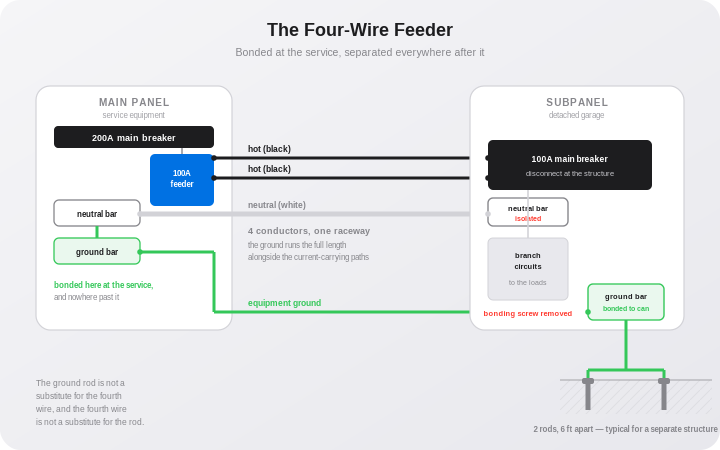
A subpanel feeder is four wires: two hots, one neutral, one equipment ground. Not three. Not three plus a ground rod. Four conductors in the same raceway or cable, with the ground run alongside the current-carrying conductors for the entire length.
The reason is bonding. Neutral and ground are connected together at exactly one place in a system — the service equipment. That single bond gives fault current a low-impedance path back to the transformer so a breaker trips fast. Past that point, neutral and ground must be separate everywhere, forever.
In practice that means three things at the subpanel:
- Remove the green bonding screw. Most panels ship with a screw that bonds the neutral bar to the enclosure. In a subpanel it comes out. Leaving it in is the single most common subpanel error I find.
- Install a separate ground bar. The equipment grounding conductors land on a bar that is bonded to the enclosure; the neutrals land on the isolated bar. They never share a terminal.
- Do not rely on the conduit as the ground. EMT can serve as an equipment grounding conductor in some installations, but a feeder to a detached building needs a wire-type equipment grounding conductor, and conduit alone is not a plan you want to defend at inspection.
The consequence of getting this wrong is not a nuisance trip. It is current on the panel enclosure, the conduit, the water piping, and anything bonded to the grounding system, whenever the neutral carries load. It is silent, it is continuous, and it turns a fault that should trip a breaker in milliseconds into a shock hazard that can persist for years.
Detached Garage: The Costs Nobody Quotes
A subpanel in a detached structure is a different job from a subpanel in the same house, and the difference is rarely explained up front. Four things get added:
Trenching. Direct-buried cable needs 24 inches of cover; PVC conduit needs 18 inches; rigid metal conduit needs 6 inches. A 50-foot trench through lawn is a few hundred dollars if you dig it, $400–$900 if somebody else does, and considerably more if it crosses a driveway, a sprinkler line, or a mature root system. Call 811 before you dig — it is free, and hitting a gas line is a much bigger bill than the trench.
Conduit and sweep. Underground runs use PVC with long-radius sweeps at both ends, plus expansion considerations and a pull string. This is the line that turns a $600 material list into a $1,100 one.
A grounding electrode system. The detached structure needs its own ground rods — typically two, at least 6 feet apart, or one if a resistance test proves 25 ohms or less — bonded to the subpanel’s ground bar with a properly sized conductor. Note that this is in addition to the equipment grounding conductor in the feeder, not instead of it. The rod handles lightning and earth potential; the wire handles fault current.
A disconnecting means. A separate structure needs a way to disconnect the feeder. The simplest compliant answer is a main-breaker panel rather than a main-lug panel, which adds $40–$100 in material and removes an argument at inspection.
Add all four and a 100-amp garage subpanel that would be $900 in a basement becomes $2,400 in a backyard. That is not a markup. It is a different scope.
Subpanel vs Service Upgrade: The Decision Table
Before you call anyone, answer these four questions in order. They sort almost every job correctly.
| Question | If yes | If no |
|---|---|---|
| Is the main panel physically out of usable spaces? | A subpanel is on the table | You may only need one new circuit — no subpanel at all |
| Does a load calculation show headroom on the existing service? | A subpanel solves it | A subpanel makes the overload worse; look at a service upgrade |
| Is the run to the new loads long (over ~100 ft) and the load concentrated? | A subpanel near the load cuts voltage drop and wire cost | A home run from the main panel may be cheaper |
| Is the existing panel a fuse box, a recalled brand, or visibly corroded? | Replace the service, not add to it | A subpanel is reasonable |
The load calculation is the hinge. It is a standard worksheet — square footage, appliance nameplates, demand factors — and any competent electrician can produce one in twenty minutes. Ask for it in writing. A contractor who says “your panel is full, you need a subpanel” without doing the math is guessing, and the guess is usually the expensive one.
Three situations where the subpanel is clearly right:
- A workshop or garage where all the new load is 20–60 amps of tools and lights, a single feeder covers it, and the main panel is out of spaces.
- An EV charger far from the panel. A 48-amp charger 70 feet away at the garage is a textbook subpanel case; the EV charger installation cost guide covers the circuit sizing and the load-management alternatives.
- A generator inlet with an interlock, where the subpanel becomes the emergency-backed panel and the transfer switch guide explains how the interlock and the main breaker have to relate.
One situation where the subpanel is clearly wrong: a service that is already at its limit. Adding a 100-amp feeder breaker to a 100-amp service does not create capacity, it creates a main breaker that trips when the dryer and the microwave run together. That is not a subpanel problem, and no amount of panel space fixes it.
Voltage Drop: When Distance Beats Amperage
Feeder length is the second half of the sizing decision, and it is the half most quotes get wrong. The NEC’s informational guidance targets 3% drop on a branch circuit and 5% total, and a long feeder eats that budget before any branch circuit does.
The practical rule I use: under 100 feet, size to the table; 100 to 200 feet, go up one size; past 200 feet, go up two or move the subpanel closer to the load.
A worked example. A 100-amp feeder, 150 feet, 1 AWG aluminum. Resistance is about 0.208 ohms per 1,000 feet at 75°C, so 300 feet of round trip is 0.0624 ohms. At a full 100 amps that is 6.2 volts of drop, or 2.6% on the 240-volt basis — acceptable, and in practice the load is rarely at 100 amps continuous. Stretch the same feeder to 250 feet and the drop reaches 4.3%, which is where I start recommending 2/0 aluminum instead. The wire price difference on that job is a few hundred dollars. The difference in how the tools behave at the far end is permanent.
What a Competent Install Looks Like
A same-building 100-amp subpanel is a one-day job. The sequence matters more than the speed.
- Load calculation and panel schedule. Decide what circuits move and what is new, before anything is bought.
- Permit pulled. Most jurisdictions require one for a subpanel; a few allow homeowner permits with inspection.
- Main breaker off, panel verified dead with a tester on the load side of the main, not just the handle position.
- Feeder breaker installed in the main panel, sized to the subpanel rating and the conductor ampacity.
- Feeder routed — conduit or cable, protected where required, secured on the schedule the code sets, with the ground run alongside.
- Subpanel mounted at working height, with the cover off and the bonding screw removed.
- Four conductors terminated, torqued to the values on the panel label. A torque screwdriver is not optional here; hand-tight is how lugs loosen and melt.
- Separate ground bar installed, equipment grounds on one bar, neutrals on the other, one conductor per terminal.
- Branch circuits landed, with AFCI or GFCI protection where the circuit requires it, and every breaker labeled in permanent marker or a printed schedule. The panel labeling guide has a schedule format that survives the next owner.
- Energize and test — voltage hot-to-neutral, hot-to-ground, neutral-to-ground, then a load test on each new circuit.
Then the inspection, which is the part that separates a real job from a plausible one. The inspector will look at the bonding screw, the neutral and ground bars, the feeder breaker size, the conductor size, the ground rods and their connections, and the labels. Those are exactly the items that get skipped when nobody is watching.
Five Numbers to Get in Every Quote
When you compare bids, do not compare the bottom line. Ask for these five numbers and the comparison becomes obvious:
| Number | Why it matters |
|---|---|
| Panel amperage and model | A 125-amp panel on a 100-amp feeder is legal; a 60-amp panel on a 100-amp feeder is not |
| Feeder conductor size and material | 1 AWG aluminum and 2-2-2-4 are not the same job |
| Feeder breaker size | Must not exceed the panel rating or the conductor ampacity |
| Grounding scope | One rod or two, and whether the equipment grounding conductor is included |
| Permit and inspection | If it is not in the quote, it is not in the job |
A quote that cannot answer all five in writing is a quote you cannot compare, and that is usually the point.
When to Stop and Call Someone
Some conditions change a subpanel job from a project into a diagnosis. Stop and get an electrician if:
- The main panel is a fuse box, or a brand with a known failure history.
- The service entrance conductors are aluminum without anti-oxidant and show heat damage.
- The main breaker is warm to the touch under ordinary load.
- The house has aluminum branch wiring — a subpanel does not make it safe, and the aluminum wiring guide explains why a bad pigtail is worse than no pigtail.
- The main breaker trips with no obvious cause. That is a load or fault question, not a space question, and the breaker triage guide covers what the trip pattern usually means.
- You cannot find the main disconnect, or the meter is combined with the panel in a way that requires utility involvement.
None of those is a reason to leave a circuit overloaded in the meantime. A subpanel is a scheduling decision; a warm main breaker is a same-week call.
The Bottom Line
A subpanel costs $450 to $2,500 in the same building and $1,800 to $6,000 in a detached one, and almost all of the spread comes from distance, trenching, and grounding scope rather than from the panel itself. The work is simple, well-defined, and cheap compared with a service upgrade — which is exactly why it gets oversold as one.
The decision comes down to two questions, in order: does the service have capacity, and is the panel out of spaces. If the answers are yes and yes, a subpanel is the right buy and the number above is what it should cost. If the service is out of capacity, no subpanel will fix it, and the honest next read is the panel upgrade cost breakdown.
Get the load calculation in writing, insist on the four-wire feeder with a separated neutral bar, and ask for the permit number. Those three things cost nothing and separate a subpanel that lasts thirty years from one that quietly puts current on the panel cover.
Frequently Asked Questions
How much does it cost to install a subpanel in 2026?
For a subpanel in the same building on a short run, expect $450 to $900 for a 60-amp panel, $700 to $1,500 for 100 amps, $900 to $1,800 for 125 amps, and $1,200 to $2,500 for 200 amps. A detached garage adds trenching, conduit, a grounding electrode system, and usually a main-breaker panel, which pushes a 100-amp job to $1,800 to $4,000 at 50 feet and $3,000 to $6,000 past 100 feet. Labor is 5 to 9 hours for a same-building 100-amp subpanel at $95 to $175 per hour. Your number moves with run length, whether the feeder is copper or aluminum, whether the wall is finished, and the permit fee in your jurisdiction.
Do I need a subpanel or a service upgrade?
A subpanel adds breaker spaces. A service upgrade adds capacity. If your main panel is physically full but a load calculation shows your existing 100-amp or 200-amp service has headroom, a subpanel solves your problem for a fraction of the cost. If the service itself is at its limit, is a fuse box, is a recalled brand, or is corroded, a subpanel full of new circuits will just trip the main breaker more often. The deciding document is a load calculation on your actual house, not the sum of the breaker handles.
Can I install a subpanel myself?
In many jurisdictions a homeowner can pull an electrical permit for their own primary residence and do the work, subject to inspection. Whether you should is a different question. A subpanel is not a good first project: the feeder terminations have to be torqued to the panel label, the neutral and ground bars must be separated, the feeder breaker must match the panel rating, and the grounding electrode system at a detached structure has its own rules. Getting any of those wrong creates a shock or fire path that stays invisible for years. If you have never terminated a feeder, hire the first one and watch.
Why must the neutral bar be isolated in a subpanel?
Neutral and ground are bonded together at exactly one point in a system: the service. Past that point they must stay separate. If you land the feeder neutral and the equipment grounding conductor on the same bar in a subpanel, or leave the green bonding screw installed, the metal enclosure and every ground path become a parallel return conductor for neutral current. That puts current on the panel cover, the conduit, and the grounding system, and it defeats the whole purpose of the equipment ground. Remove the bonding screw, install a separate ground bar, and land neutrals on one bar and grounds on the other.
Does a detached garage subpanel need its own ground rod?
Yes. A feeder to a separate structure requires an equipment grounding conductor run with the feeder, and the separate structure also needs its own grounding electrode system, typically two ground rods at least 6 feet apart or one rod if a resistance test proves 25 ohms or less. The rod does not replace the equipment grounding conductor, and the equipment grounding conductor does not replace the rod. Both are required, and neither one is a substitute for the other.